Showing posts with label Books. Show all posts

Thursday, April 5, 2012

All ingredients need salt.


"All ingredients need salt. The noodle or tender spring pea would be narcissistic to imagine it already contained within its cell walls all the perfection it would ever need. We seem, too, to fear that we are failures at being tender and springy if we need to be seasoned. It's not so: it doesn't reflect badly on pea or person that either needs help to be most itself."

-Tamar Adler from An Everlasting Meal

Sunday, February 26, 2012

Soil Life and Your Garden- Something to Consider


 I was trying to think of  catchy, attention grabbing title for this post.  I had something like Microscopic entities grow Giant Kale!  with "and, lettuce and broccoli and sweat peas......" heading up the text.  I went with a much 'quieter' heading, but as Sci-Fi fantastic as it sounds, those kale growing micro-organisms are as real as you and I.

As spring approaches and we start planning and preparing our vegetable gardens, it's a great idea to take some time to learn about the life within the soil.  I've read that a double handful of good garden soil contains more living organisms than there are people on earth.  It's true.  With billions of bacteria, countless yards of fungal hyphae (threads), hundreds of protozoa, dozens of nematodes, and don't forget the earthworms, arthropods, and gastropods there's a lot going on down there!  Sound scary?  It shouldn't be.  Healthy garden soil has a work force of microbes (microscopic organisms) that provide food, water, pest and disease protection, and nicely aerated soil for your plants.  There are certainly 'bad guys' in the soil- bacteria, fungi and nematodes to name a few- that are out to eat your plants. The idea is to foster a large and diverse population of soil life to keep the harmful organisms in check. 
Over millions of years plants have evolved intricate relationships with bacteria, archaea, and fungi in the soil.  In nature, plants actually expend some of the energy from photosynthesis to create "exudates." These excretions from the plant roots contain carbohydrates, proteins and minerals specifically aimed at attracting bacteria and fungi into the area within their root system.  That may seem crazy at first, but these organisms are responsible for 'fixing' nitrogen so it is in a form available to the plants, as well as searching out, unlocking and transporting critical phosphorus, water and other nutrients. One of the most well known examples of bacteria and plant symbiosis is with legumes.  Plants like clover, sweat peas,  beans, and vetch are great companion plants and cover crops because they add nitrogen to the soil.  However it is actually different species of Rhizobia bacteria that will 'infect' the plants root tissue and then from inside the roots convert nitrogen to an available form for the plant to use.  In exchange the bacteria gets carbon and air from the plant.
If we're talking vegetables a few things to remember: They rely on different types of bacteria working "together" to provide nitrogen in the Nitrate form they prefer.  You may know that vegetables prefer a pH of 7 or just below.  What you may not know is that these beneficial bacteria also prefer a pH of 7, and without disruptive influences from us, the protective film bacteria create around themselves will slowly raise the pH of the area around them to 7 to help their numbers grow.  Other plants like trees and shrubs tend to prefer somewhat more acidic soils and have built relationships with fungi who also want more acidic soil and create acids themselves that will lower the pH of nearby soil!
Bacteria are also the main food stuffs of earthworms.  Earthworms may eat soil and organic matter, but what they are really after are the bacteria attached to those particles.  It is then up to other bacteria in the gut of the earthworm to process what they have ingested.  The earthworm waste, or "castings" created by this process are considerably higher in nitrogen and other critical nutrients than the matter they'd consumed.
Growing organically, adding compost, properly made compost teas and organic matter to your soils, mulching with shredded leaves, green mulches and shredded pine bark for the veggie garden are all great steps to take in support of healthy soils.
This is a huge topic, with books written on every different type of participant in the 'Soil Food Web'.

I love learning and talking about this stuff! In  my classes it so great to see people be as surprised and amazed as I first was to realize just how much life is in the the soil, and just how much the plants depend upon that life. 
Want to learn more on your own?  A lovely resource is the book Life in the Soil by James Nardi. An education and guide is also provided by the book Teaming with Microbes: The Organic Gardeners Guide to the Soil Food Web.   You can also check out the USDA-NRCS page on soil biology by Elaine Ingham.  There you'll find some very sciency talk and lots of great electron microscope images. Or if you are really getting into it, how about the website for The American Society for Microbiology?

Sunday, February 19, 2012

'The Happiness Diet'

  If you know me then you know I can be a bit of a nerd, and my interest in food is no exception. I  just cracked open a copy of  The Happiness Diet by Tyler Graham and Drew Ramsey MDThis book with a fat, yummy looking hamburger on the cover is subtitled A Nutritional Prescription for a Sharp Brain, Balanced Mood, and Lean, Energized Body.
I'm not a self help book kind of gal, and I'm wary of anything that tries to restrict the benefits of any whole food to one nutrient or chemical. I'm also wary of those short lists like "Five Foods To Make You Smarter."  I believe variety  is key.  The authors of this book agree, even if they use some handy short lists for people to work from.   The Happiness Diet  looks and sounds like a conventional self help sort of book, and in many ways it is. Some of the information in the book seems rather over the top, and it even has it's own infomercial like website with lots of 'Order Now,' 'Don't Wait' etc. Really, I don't know what to make of all this!
Mostly though my brief perusing has been rewarded with interesting food facts, and tips on buying, storing, and preparing whole foods. It talks about the mood lifting B vitamins found in beets, and why we should be eating meat that's pasture raised
 The second time I opened it up I landed on a short paragraph on oranges that gave their peak season, which ones are not good for juicing (Navels), and that you should buy organic because quote..."conventional oranges are often injected with artificial dye to give them uniform color."  Is this true? That's something I didn't know.  They also have "100 Reasons To Avoid  Processed Foods"  in little boxes throughout the book.  Helpful information on selecting, storing, and preparing whole foods is mixed in with those often scary little info. boxes concerning processes foods. It has pages of recipes, a weekly meal plan, information on the workings of the human brain, and to boot its got a positive review by  Nina Plank who wrote one of our favorite books 'Real Food: What to Eat and Why.'  Perhaps we are overdue for this sort of self help book. A book clearly made for the mass market that names and explains why Mesclun is the top food for energy and houses chapters with titles like 'This is your brain on food'  has my appreciation.

Friday, February 10, 2012

Inspiration


"A significant part of the pleasure of eating is in one's accurate consciousness of the lives and the world from which food comes."

Thursday, November 17, 2011

Popovers

Popovers were introduced to me by my husband. It might not be an overstatement to say he courted me with them. They make a such grand and imposing breakfast feast- who wouldn't be wildly impressed?

For years popovers were Ned's domain at our house. Ned grew up eating them with his "Grandpa." It was a special treat made by request from the grandkids, a tradition he has now passed on to our kids. And I was always under the impression that there was a trick, a secret family recipe or some cooking mojo that coaxes these things to "pop over" that was in his genes.

Until one morning recently, when the kids and I got up early to make them for Daddy as a surprise. Ha! As it turns out, I was the one who was surprised. He's got us all hoodwinked. They couldn't possibly be easier to make and yes they just "pop over" all on their own.

Somewhere in the distant foggy past, these eggy muffins were derived from Yorkshire pudding, which is made savory with the addition of pan drippings from roasting meats. You can certainly tweak this very simple recipe with the addition of some herbs, parmesean or savory spices and eat it along side a stew or soup.

So, while I have somewhat demystified the popover, I'll let them continue to be Daddy's domain- and quite happily reap the benefits. Which, at our house means using the deep hollow hole naturally made inside the popover for a slab of butter and hearty messy drizzle of honey. Amen.

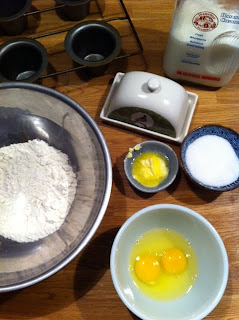
We use a popover tin (considered sacrilege by purists I hear, Grandpa would not be impressed) but seeing the before and after, these beauties are pretty fabulous. But a regular muffin tin will work fine.

The recipe couldn't be simpler. This one is from one of our kitchen staples, The Joy of Cooking.

Preheat oven to 450°

Oil muffin tin to prevent sticking.

In a large bowl measure:
1 cup all purpose flour
1/2 teaspoon salt

In another bowl measure:
2 large eggs
1 1/4 cups milk
1 tablespoon warm melted butter

Add the wet ingredients to the dry. Mix and fill the tin 2/3 of the way full.

Bake for 15 min at 450° and then turn the heat down to 350° and cook another 20min.

Oh and don't be tempted to open the oven early unless you want to watch them deflate :)

Enjoy!


Thursday, October 20, 2011

Cookbook Love: Heidi Swanson

Okay so maybe I have a problem with cookbooks. I openly admit it, but in the spirit of sharing all things good, I can't possible say enough about Heidi Swanson of Super Natural Cooking and Super Natural Every Day. You may also know her from the fabulous blog 101 Cookbooks (she obviously has her own issues... maybe this is why I love her?)

Now to be honest about my cookbook library, some books in my collection get more use than others. Some are treasured for their beautiful photography and others are staples falling apart at the seams from overuse, and others are just gathering dust (but I just can't seem to part with them.)

But Heidi is all about good whole food ingredients, a lot of which I usually have on hand, so I tend to reach for her books all the time. One of our favorites are her Otsu Noodles, soba noodles with a ginger sauce made at my house with baby onions from the garden and Twin Oaks Tofu (read more about our great visit to Twin Oaks here.) Also in her second book Super Natural Every Day she does a special take on these noodles with a black sesame sauce which we recently fell for. (This one with its rich black suace would also make a perfect Halloween dinner party main course.)

Also we love her Grain-ola, Rustic Cabbage Soup, Hedgehog Potatoes, Kale salad with toasted coconut and Oatcakes (which are like granola in muffin form and great for a quick breakfast.)

So if you don't know Heidi you should, and if you do what are your favorites?

Thursday, September 22, 2011

"Canning for a New Generation"


In the spirit of the upcoming Yes We Can! event, I thought I'd share my new favorite canning book; Canning for a New Generation by Liana Krissoff with photography by Rinne Allen. These two ladies from Athens, GA know how to can it. The book is organized seasonally (my favorite way) with a nice introduction that takes you through the basics. Or if you already have some canning experience, you can jump right into cardamom plum jam, hot pickled okra and tomato and cashew chutney (!) Also, many of the canning recipes are followed by other exciting recipes in which to incorporate your newly canned goods. Oh, and if all that hadn't already won me over, there is a a recipe for "The Perfect Sidecar" finished with Brandied Sweet Cherries, um... yes please.

So, for now I plan on starting with Red Onion Marmalade with the canning swap in mind... okay spreading it on slices of crusty bread layered with a slab of aged cheddar is not bad for inspiration too. Come on, yes you can!


Yes We Can! Details
November 5, 2011
3 p.m. to 5 p.m.
Location TBA
And it's all free! You just have to bring something to swap!
Register by email: richmondfoodcollective@gmail.com
Send your name, your products and about how much you will be bringing

Saturday, November 13, 2010

Mark Winne Speaking This Sunday and Monday Nov. 14, 15

Mark Winne, author of Food Rebels, Guerrilla Gardeners, and Smart-Cookin’ Mamas will be speaking at two locations this Sunday and Monday on the topic of his second book.

Mark Winne will be speaking at:
The Harrisonburg Barnes and Noble at 289 Burgess Rd. on Sunday, November 14 at 1pm.

Mary Baldwin College in Staunton, November 15 (Monday) at 7:00 PM in the Hunt Gallery on the campus of Mary Baldwin College.
To visit Winne's web page, and read more on his latest book click here.

Tuesday, September 7, 2010

Book Reccomendations From My Summer Reading List


This summer I've been in a bit of a funk. I'm a gardener and the endless weeks of 100+ degree days, the lack of rain coupled with hellacious swarms of Asian Tiger mosquitoes had me running for cover. At home my garden was largely left to make it's own way to fall, and it's got the dead and stunted plants to prove it. Within the comfort of my air-conditioned, and mosquito free house I sought out inspiration to fight the fight again next season.
Gardening, and most certainly agriculture, can turn your entire perspective of nature on it's head. I would need all ten fingers and ten toes to count up the various assorted diseases and pest that have just this summer taken to stealing, eating, weakening, or outright killing my plants in the name of their own survival. Covered in Deet, wide brim hat, and a touch of poison ivy, heading outside can seem more like warfare than convening with nature.

To the rescue cam Susan Hand Shetterly's new book Settled in the Wild: Notes from the Edge of Town. This beautiful book speaks to a love of place that encourages us to love the natural world of our own space, our own yards, neighborhoods, towns, and remaining wild places. Learning to understand, care for and respect the wildlife that surrounds her Maine home has been the work of Shetterly for the last forty years. A perfect quote on the front cover by Terry Tempest Williams says " I read [this] not only with great delight, but with a yearning to stay put and live more fully."
In one passage that has stayed with me Shettery, after describing the loss of the great alewife migrations, speaks perhaps to a common appraisal that what wild spaces left to us are not truly wild, possibly not worthy of our admiration, attention or protection.


Quote: " 'Nobody owns anyone, except in memory,' John Updike wrote. I suppose that goes for owning wild migratory fish in a hometown stream as well. We can spend our lives regretful. We can watch three ospreys and want a dozen. We can hear the shattering screams of twenty gulls and know that true cacophony is a hundred of them, each one insisting on its own insatiable hunger. We can want fish we can walk over, but those are [another's] memories, not ours. I would like to see what he saw, but I don't dare miss what is here now."
I will admit that nearly every section of this book brought tears to my eyes if not for it's sadness than for it's beauty.

Next on my list Gary Naban. That's Gary Naban, period. Okay, I have only read two of his books. I have just started the third. Erin has read and loved the forth, and my friend Lucy who finally pushed these books into my hand swears (as many others do) that everything he rights is absolutely worth reading. His writings are also works on place and how where we come from effects who we are and what we should, or even can eat. His work always seems to be far ahead of the curve. For example, Naban wrote "Coming Home to Eat: The Pleasures and Politics of Local Foods' for publication in 2001. That is, in the year 2000 Naban at only foods that could be harvested, foraged, or hunted from within 250 miles of his Arizona home! An interesting comparison to Barbara Kingsolvers' 'Animal Vegetable Miracle' which starts off describing how Kingsolver decided she must move her family from Arizona to West Virginia in order to live off the land. Granted, Naban also eats some road kill, and one of Kingsolvers stipulations was that she would not be feeding her kids from the roadside. She was referring to dandelions, but that's just the point. Naban's approach is to look towards those traditional and wild foods of the land, the prickly pear cactus, peppers, and wild animals and discover the benefits of such foods.

I just finished reading his 2004 book 'Why Some Like it Hot: Food, Genes, and Cultural Diversity.' This amazingly interesting book delves into the genetic difference that cause people to respond differently to various foods and drinks, not as individuals, but as a people who share specific genetic adaptations to the environment of their ancestors. Why some people become anemic when exposed to fava beans, why others are so effected by refined grains and alcohol, and why some of us love to eat hot peppers and bitter greens, while others can't even stand the thought.

His book 'Renewing America's Food Traditions, Saving and Savoring the Continents Most Endangered Foods' was published in 2008. A big book filled with photographs, and recipes it's a sort of coffee table book on endangered foods. The Fish pepper I did the LGBG video on is in there, as is the Fainting Goat, and the Blue Crab. Divided up by sections like "Crabcake Nation" and "Bison Nation," Naban looks at some of the best traditional foods, and how those foods helped define different regions of our country.
Check out his official site here for many more books, videos, and information on his lectures.

Monday, June 28, 2010

Recommended Reading... The Earth Moved: On the Remarkable Achievements of Earthworms

Amy Stewart's 2004 The Earth Moved is an eye opening, engrossing tribute to the lowly earthworm. I have read more than a few books that deal with soil life and worms. I have two worm bins, and care for my worms with the concern of caring pet owner. However, Stewart's book taught me that I still have much to learn. Leaning heavily on the years Charles Darwin spent researching and writing about earthworms, as well as interviews with some of today's top researchers, and academics on the subject The Earth Moved covers a lot of ground. At the same time Stewart's writing caries enough of a personal perspective and voice to make it a completely absorbing and entertaining read. To my mind this is one of those works that everyone should read whether they have not ever given worms the slightest thought or already believe they know all they need to know on the subject. With over forty rave reviews lining the first three pages of the book, there seems to be some consensus.

Saturday, April 3, 2010

New Book: The Town That Food Saved

For those of you who read Barbara Kingsolvers Animal, Vegetable, Miracle you might remember her summer vacation trip that took her to Hardwick, Vermont. This small town was built on the granite industry. When that industry shifted to China the town floundered. Kingsolver introduced readers to a family that built first a diner and then a meat processing plant just to preserve one the remaining sources of income for local residence, farming. Her description of the diner that was started in this small town just to provide an outlet for the goods of local farms was truly inspiring. Filling, fun, locally grown, and prepared hot meals for just ten dollars! Where is the Richmond version of this place?!
Now there is a new book by journalist, and Vermont farmer Ben Hewitt that tells the story of this towns revitalization and the vital role local and artisanal foods played. Check out The Town That Food Saved. I just started reading my copy this morning, and it promises to be a great read on the subject of local food and it's importance to our health as individuals and our communities.

Saturday, February 27, 2010

New Books We Recommend : AKA Marion Nestle is Amazing!

New Books we Recommend: AKA Marion Nestle is Amazing!

I've just about finished updating our "Books we Reccomend" section and suddenly had to stop and quickly write a few words about Marion Nestle and her website Food Politics. While we here at the RFC are usually speaking from a position outside of our greater food system, Nestle has been working for decades to improve that system from within. A prolific writer and outlandishly informed and insightful educator on the topic of our food system, Nestle seems to cover all the angles with such enthusiasm and charm it's hard not to sit up and pay attention.
Her book on the pet food industry and what it says about our food system, Pet Food Politics: The Chihuahua in the Coal Mine is on my reading list. A passage from her site states that "The story told in Pet Food Politics demonstrates how food for people, farm animals, and pets is really much the same. We only have one food system. A safety problem in any part of it affects food for all. The pet food recalls should have warned us all that the food safety system needed fixing, and right away. The peanut butter recalls of 2009 show what what happens when such warnings go unheeded."
Nestle's Books include Food Politics: How the Food Industry Influences Nutrition and Health. The website includes reviews of the text from the likes of Julia Child who stated that “In this fascinating book we learn how powerful, intrusive, influential, and invasive big industry is and how alert we must constantly be to prevent it from influencing not only our own personal nutritional choices, but those of our government agencies. Marion Nestle has presented us with a courageous and masterful exposé.”
Even if you don't read her books you should check out her blog. I just picked up more than a few great bits of information in a matter of minutes Including news of chef Jamie Oliver's upcoming T.V. show depicting his attempt to overhaul the food in one notoriously unhealthy West Virgina public School.
Nestle, who is speaking today in D.C. at the USDA also has an updated eddition of her 2003 book Safe Food coming out this spring.

Friday, February 5, 2010

Michael Pollan, Oprah, Food Inc., Chipotle, And More

So if you haven't heard, Michael Pollan has written a new book , Food Rules. I didn't write about this sooner assuming that for those of you who are already reading this blog Food Rules ( a condensed, simply and smartly stated set of rules based on his two previous books) would perhaps be old news.
However, this new book is getting a lot of press, valuable press for those who care about the health of our food system. This week Pollans new book received good press in a NY Times article that was apparently one of the most e-mailed articles from The Times. You can read the article Here. Last Thursday Pollan appeared on Oprah to discuss the basic tenets of Food Rules. The episode started with a seen from the film Food Inc. that featured Michael Pollan among other important players like Joel Salatin. Oprah implored to her viewers to watch the film, read Pollan's book, and make up their own mind. To that end Oprah offered a discount through Amazon for anyone who would like to purchase the DVD of Food Inc. A Code given at Oprah.com gives you a discounted price of $9.99. Just click Here to read all about this episode and then scroll down to the Food Inc. on DVD" link. It's on Amazon with out the link for $10.16 at this time. If you think you know all about Pollan and Food Inc. already, you might be interested in the portion of this episode that featured the founder of Chipotle discussing his efforts to use fresh, local produce as well as meat that is more humanly raised.

Thursday, September 10, 2009

Anti-Locavore Book...


James McWilliams has come out with a book lampooning 'eat local' activists and proposing a solution to our food system crisis that includes the use of pesticides and genetically modified crops. I haven't read this one yet, but let's see what some of the critics have to say...

Grist:

'“The locavore approach to reforming our broken food system has serious limits-limits that our exuberant acceptance of eating local has obscured,” McWilliams writes. In their application of a simplistic valuing methodology (judging food purely by how far away from one’s plate it originated), he claims, these 100-mile dieters could potentially do more harm than good, if they succeeded in their apparent mission to force the entire world’s eaters to choose food grown within a short drive of their kitchen table.

The problem with this argument is its irrelevance. The few truly orthodox locavores who presumably exist (do you know even one?) aren’t close to persuading the world to eat the way they do. To devote an entire book to debunking the impulse to eat closer to home doesn’t address the points raised by food and farm activists. At their most relevant, today’s alternative eaters illuminate the systemic problems created by industrialized food provisioning: negative impacts on the global climate as well as significant deterioration in water quality, soil quality, local economies, worker justice, and human health.'

Reason Online:

"[McWilliams] makes it clear, as diplomatically as possible, that the idea of using organic methods to feed the world's population—projected to peak at nine billion in the second half of this century—is a pipe dream. More like a nightmare, really, given how much pristine land would have to be plowed under to compensate for the lower yields of organic agriculture and how many megatons of manure would have to be trucked hither and yon. McWilliams boldly but ­correctly calls for "dispensing with the organic/conventional framework" altogether and ­instead focusing on the costs and benefits of specific ­methods and technologies."

Amazon Online Reviewer:

"Just Foods is an important book in the continuing (and continually escalating) debate over how we should grow our food and what we should eat. Environmental historian and reformed locavore James McWilliams, invites us to think logically and dispassionately about some of the most important food issues of our time--and of the future. Having read two of McWilliams' previous books, I expected a controversial, detailed, and well-documented discussion. I wasn't disappointed."

So, while we are all tempted sometimes to spend our days only watching MSNBC or Fox News, of course we all know it's best not to immerse yourself only in media that supports your current belief system. I'm curious to hear McWilliams' point of view, and to draw my own conclusions about whether or not he is making a valid argument. Anyone who has read this book, let me know! I do want to point out that I do not believe in the 'population crisis' argument -- that GMOs, pesticides and other artificial means will be necessary to feed the skyrocketing number of people on this Earth. We are already in an extreme state of overproduction, growing plenty of food to feed, in the very least, our own population in the US. The problem is that all of it is feed corn for industrial beef, and those who are starving, regardless of how much food there is in the world, will continue to starve because they have no means to access that food.

Still, I haven't read the book. As a final comment, it's kind of funny that there are people out there arguing against locavorism, since overall it tends to be such a benign, feel-good movement out to make people happier and healthier. And I do have doubts about these arguments (like the one behind this NPR article) that attack certain movements or ideas for little more than not doing 100% of what they are purported to accomplish. Locavorism may not be perfect (for example, as the Grist author mentions, we can't feed everyone on an orthodox locavore diet) but does that mean the idea as a whole is pointless, irrelevant, or actually damaging to the earth and human society? Obviously not.

Monday, August 3, 2009

My New Book List

I love shopping for new books! Love, Love, Love it! Of course there are always two impediments to actual book buying the first being time the second being money, but isn't that the case for just about everything in this world. Yesterday I was able to spend a little time in the Barnes and Noble and walked away with Little Heathens :Hard Times and High Spirits on an Iowa Farm During the Great Depression by Mildred Armstrong Kalish. I've been talking a lot lately with a good man I know who happened to grow up on an Iowa farm during the great depression, still owns the farm and, at eighty years old, travels back to Iowa several times a year to help with the farm work. After talking with him I couldn't pass up this absorbing and inspiring looking memoir. With great reviews by Elizabeth Gilbert and others.

I also walked away with The Gardeners A-Z Guide to Growing Organic Food by Tanya L.K. Denkla (1994, updated and republished in 2004). Since 1997 she has worked as Senior Associate at the UVA Institute for Environmental Negotiation. Within the last couple of years she has also helped found and conduct the Virginia Natural Resources Leadership Institute. This is on top of finishing her pre-med requirements and writing one of the most successful organic gardening guides around. As always, however, there were way more books than could fit in my basket. Here is a quick run down of five more I'm adding to my reading wish list (with their links to amazon.com all with free supper savor shipping! Whoopee!

1. Farm City by Novella Carpenter. This book is being reviewed by everyone, positively. Chronicling Carpenter's experience farming inside a troubled Oakland California neighborhood, Farm City gets into the head on gritty of urban Oakland farming... reputedly with wit, intelligence, and compassion.
2. Life is Meals: A Food Lover's Book of Days by James and Kay Salter. This book contains all kinds of practical, historical, and fantasmical information about food, and it's preparation, preservation, presentation, and of course, it's consumption. Mostly this book is beautiful! I was so tempted by it's pretty pages.

Sunday, May 24, 2009

Michael Pollan on Steven Colbert

Last Wednesday Michael Pollan was a guest, for the second time, on Steven Colbert. Although Michael was of course unable to really get out any information, the interview is entertaining.
You can Check out the short clip Here.

Monday, April 6, 2009

Amy Stewart

For those of you who haven't picked up one of Amy Stewart's bestselling garden books It might be time to reconsider. If you haven't heard of Amy Stewart she is a garden writer with several articles and four books under her belt.
--Flower Confidential: The Good, the Bad, and the Beautiful in the Business of Flowers
This work poses some of the same questions about flower production books like Plenty and The Omnivores Dilemma do about food production. Should we be concerned about genetically engineering flowers to be free of pollen, or to be blue? Should we care that flowers are grown with thousands of gallons of pesticides, and then flown thousands of miles on chilled cargo plans to provide us with summers beauty year round? Which makes her January 2007 op ed piece for NPR all the more perplexing.... A response to the word "locavore" making word of the year, Stewart's response was "It's Time for 'Locavores to Shut up and Eat." Locavores beware! One note, Stewart's (lets say snarky) comments for this NPR piece were more than two years ago. All signs seem to indicate that plenty of other people recognize the importance of preserving agricultural land, the environment, natural resources, our health, and our connection to the land as well as the wonder that major improvements in all these areas can be accomplished through what she calls "just grocery shopping".


--The Earth Moved: On the Remarkable Achievements of Earthworms
An excerpt from her website says, quote: The New York Times called it "a completely original combination of science and passion." This is a fascinating exploration of the underground world and one of its most amazing denizens. The earthworm may be small, spineless, and blind, but its role in the ecosystem is profound. It tills the soil, destroys microscopic organisms that cause plant disease, breaks down toxins, and turns the ground into rich compost, creating the most fertile areas on earth. In her witty and offbeat style, Amy Stewart shows just how much depends on the humble worm.

-- From the Ground Up: The Story of a First Garden This was Stewart's first book and it tells the story of her own gardens evolution, pitfalls and all.

Now, she's added to her list of accomplishments with her newest work called Wicked Plants: A Book of Botanical Atrocities. This new work tells the tales of many a poisonous and dangerous plant, the disastrous results of our ignorance of these plants and the maniacal ways in which some of them have been used .
Please Click Here to check out her fabulous video promotion for Wicked Plants.

Click Here to check out Amy Stewart's blog, called simply Dirt. There you'll find easy links to her website and her books page.

After writting this I found two interesting responses to Stewart's comments on NPR.
http://www.eatlocalchallenge.com/2008/01/shut-up-eat.html (a whole host of good comments to keep things in perspective)

Working with Nature, a book review and musing

As we head out into our gardens this spring I feel the need to lament the combative perspective so many good people take when it comes to life in the garden.
Some good friends of mine moved out to the country. Land was cleared, a house was built, then a garden, followed by a small pond. The garden attracts rabbits and birds and mice to which vast amounts of netting and cages are engaged in battle. The pond attracts frogs, hungry for clean water in which to lay their eggs. The eggs are unwelcome because the frogs make too much noise.
I live in the city, where apparently even the bees that pollinate our plants are considered technically a "nuisance." That first year in my yard I walked the mostly unmowed space only to have a startled snake scare the breath into me. Now the yard is mowed and I haven't seen, what was probably a very helpful snake, in the five years since. I also have rabbits (perhaps because I no longer have snakes). I enjoy seeing them hop around the yard eating the clover that covers my "lawn." The clover keeps my rabbits happy, butt the lettuces and fresh spring vegetables are always in danger, raised beds and hardware cloth have become my means of defense. Thankfully, I don't have a problem with deer, but what about the slugs, snails, squirrels, raccoons and mice? In my work, I hear complaints about everything from crocus stealing chipmunks to berry stealing Robins.
The life in your soil, is the most valuable resource a gardener has, and it also depends upon all that other 'irritating' life above ground. Earthworms, nematodes, protozoa, arachnids, bacteria, fungus, mollusks and even mammals are all important parts of "the soil food web." Yes, I have been reading a lot about soil lately and the more I read the more I understand just how invaluable each and every life is to our natural environment, including the garden.
One of the two books I am reading right now is Teaming With Microbes by By Jeff Lowenfels, Wayne Lewis, and Elaine Ingham. This book will grab any gardener who dares just to read the preface! With amazing photographs and well written, story like chapters on each of the lifeforms that makes the soil-plant relationship sustainable this book will have you rethinking how you treat your soil and probably cause you to tread a little more lightly. The first half of the book dedicated to filling you in on all that life and all of the very important work it must do. The second half of the book is dedicated to teaching you how to best support that life, via compost, compost teas and much more. Click Here to read on Google Books.

The second book I am finally getting to is Dirt: The Erosion of Civilizations by David R. Montgomery. I will refrain from writing too much here since Natalie has already written a wonderful review of this work. I was afraid this book would be too daunting and depressing, but instead I have found it to be so full of amazing information and powerful stories I can hardly put it down. In the midst of developing his main message about the importance of protecting soil as one of our primary life sustaining resources, Montgomery engages you with information on Charles Darwin and the last book of his life (it's on earthworms), why the soil in the worlds tropical regions doesn't support agriculture, what caused the dust bowl of the 1930s, or the interesting question he poses concerning the Mayan, Roman, and Greek civilizations all lasting approximately 1,000 years. Click Here to check it out on Google Books.

For most of us, gardening is a bonus. The loss of a lettuce or summer squash is frustrating for sure, and when times are tight it is even more upsetting, but it is my opinion that finding ways to live with all the other life out there is more important than the loss of your ornamental holly berries, or the occasional tomato. As angry as it makes us to see that fruit with just one bite taken out, how many of those fruits do we to often let rot on the vine or on the ground below? Perhaps on some sunny day, we can pause to enjoy the garden and a good book, take a break from our garden warfare and pause to think about how to better live in harmony with all those 'pests,' and to nurture the soil life, and garden life that in the end nurtures all of us.

Tuesday, March 24, 2009

Dirt: The Erosion of Civilizations Book Review


Dirt is the kind of book that, despite its academic tone and a profusion of dates and historical facts, still manages to scare you. David Montgomery, a geomorphologist and professor of Earth and Space Sciences at the University of Washington, seems to be both fascinated and terrified by his studies of the patterns and changes in the earth beneath our feet. Throughout the book he takes us to Egypt, the Amazon basin, the American Midwest, China and Peru (among others), providing countless examples of civilizations that succeeded or failed due to careful stewardship or careless mining of soil, unquestionably (as I have concluded) our most precious natural resource.

It's simple, see: without fertile soil we can't grow plants. No plants means no food. Without food...well, you get the idea. And we have been mining our soil, using up the natural fertility, and moving on since time immemorial. A repeating pattern of fertility loss, erosion and human migration emerges as, across the world, humans continue to make mistakes. The problem is that soil time is much slower and harder to percieve than human time: these changes take place over hundreds of years. So those farmers who neglected to return nutrients to the soil through manuring and cover crops had little to no perspective on how they were permenantly changing the landscape of their own agro-ecosystems. Societal and cultural pressures don't help; slavery, economics, poverty, agrochemistry, monoculture crops for export, corrupt governments, those in power motivated by little else than money. It's all in here, and yes...it's scary.

I guarantee this book will permenantly change your perspective on food and agriculture. Erosion, in particular, is a predominant theme. Many of us are concerned by the contamination and depletion of soils by 'Big Ag,' using gallons upon gallons of pesticides and synthetic fertilizers. These issues are addressed as well; however, it's important to realize that we have been ruining soils since long before anyone had any idea about NPK. Erosion of fertile topsoil is a huge concern, and we come to realize that clearing land for farming is a dangerous prospect.

Another revelation in this book (for some) is that poverty and hunger will never be solved by increasing the worldwide supply of food. Hunger is a food distribution issue, not a food availability issue, illustrated by the example of Ireland's infamous potato famine: shiploads of meat were being sent off to England as the peasants starved on fungus-infected potatoes. They had been forced to move away from Ireland's already small area of fertile lands (which were being farmed for export of crops and animals) and ended up in marginal locales where little else was possible to grow. It stands to reason that Montgomery is against GMO crops, as he believes that the companies who distribute them, regardless of what they say, are motivated by other desires than to end world hunger. We need to be teaching substinence farmers how to conscientiously grow crops and build soil so that they can grow what they need to survive.

It takes thousands of years for topsoil to form: once it is gone, it is gone for our lifetimes. And we are already farming, says Montgomery, almost all the arable land on the earth. With the population expected to double in the next century, it will be impossible for modern agriculture to continue to deplete the soil at its current rate--that is, unless we want to lose a lot of those new people to starvation. Where have we been, and where are we going? Montgomery quotes Marie Antoinette: There is nothing new except what has been forgotten. This book is a journey: one that takes you through time and across the earth, then pulls you from blind indifference into a passionate, disturbed understanding of what lies beneath our feet.

Monday, February 9, 2009

Dirt! The Movie

Am I allowed to be this excited about dirt? Absolutely!! Soil is what gardening is all about, and it's also the subject of a new and (at least for me) exciting documentary called Dirt! The Movie. Dirt is definitely one of those ignored issues (especially when we're all up in arms about economic insanity), but it is without question more important than most people think. Check out the trailer for Dirt!:


Chris Lawrence, State Agronomist for the National Resources Conservation Service, recommended this movie at a recent horticulture conference.

Also, co-blogger Shannon recently recommended a book concerning similar topics: Dirt: The Erosion of Human Civilizations, by David R. Montgomery. According to a review on the Amazon website: "Montgomery...argues persuasively that soil is humanity's most essential natural resource and essentially linked to modern civilization's survival." I haven't read the book yet but I'm excited. When I went to see John Jeavons (GROW BIOINTENSIVE guru extraordinaire from California) speak at EMU, I remembered hearing him say 'peak soil' all the time. I was eager to hear more science and hard facts concerning the current situation with our total agricultural land and whether or not we have really reached a peak...

In any case, both of these resources sound like good motivation for getting your own compost bin cooking. Just because you're cutting down on 'discretionary' spending doesn't mean you can't afford a compost thermometer!